MerchlandB2B marketplace with a quote-to-order ERP
- Custom Software Development
- UI/UX Design
- ERP & Enterprise Systems
- E-commerce
- B2B Platform
- Kolkata, India
- Live site
01 — The Challenge
One system that owns the order.
Merchland asked us to build the platform end to end: the storefront buyers shop in, the network vendors bid through, and the quote-to-order machinery between them.
There was nothing to model from. No vendor APIs, no order files, no price lists to import — pricing, capacity and lead times lived in people's heads. Every rule in the system had to be reconstructed from how the trade actually worked, then written down for the first time.
And nothing could be bought off the shelf. Off-the-shelf commerce assumes a price on a product, stock in a warehouse and a checkout at the end. Merchland has none of those: prices belong to vendors, capacity replaces stock, and every order is a quote against a fixed delivery date. Every assumption had to be replaced, not configured.
02 — The Catalogue
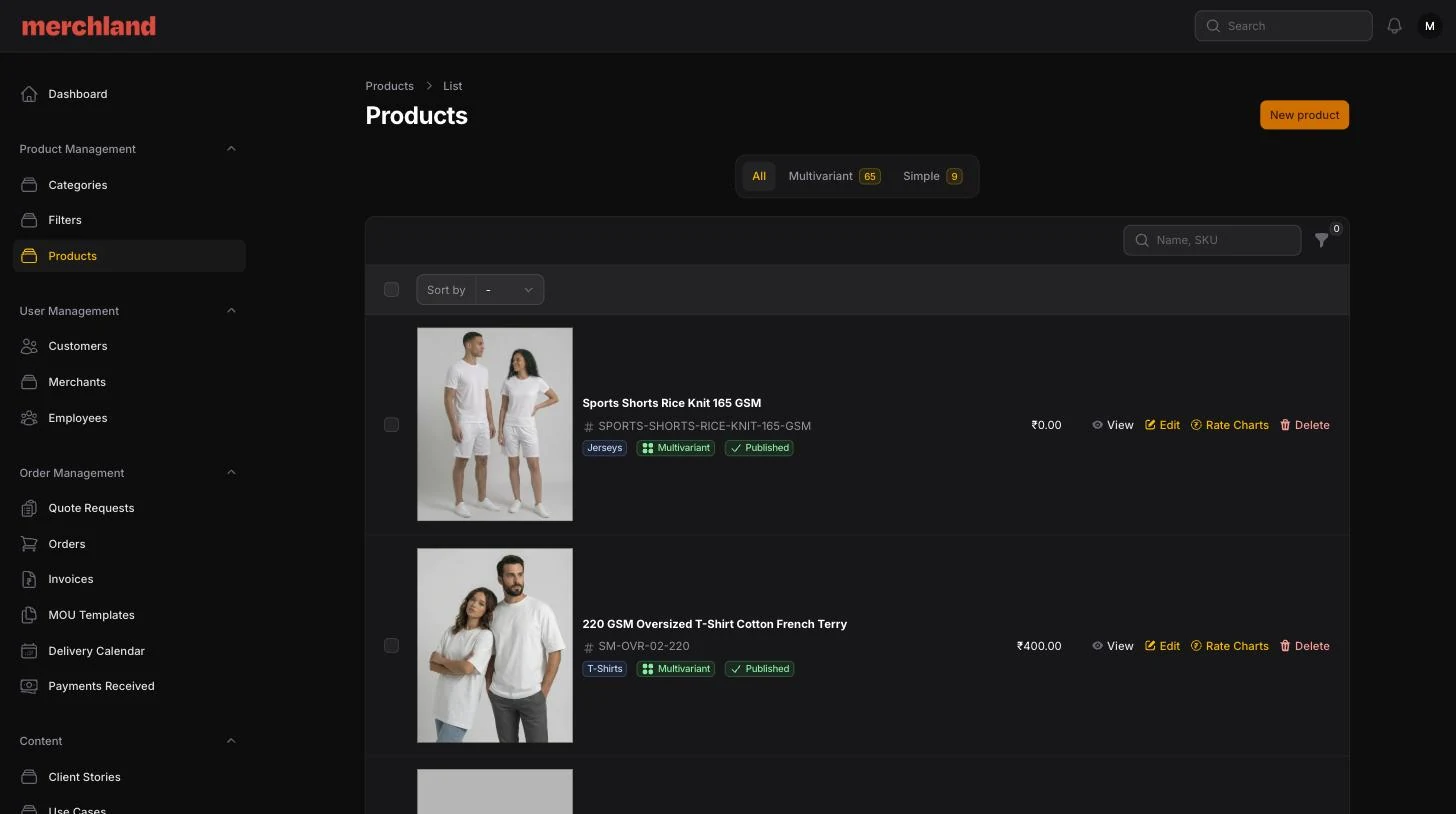
Product catalogue with multi-tier vendor pricing.
The first assumption to go was the price tag. The catalogue holds combinations — GSM, colour, fabric, treatment, size — and no prices. Price lives in vendor rate charts instead: quantity tiers tied to the exact slice of the catalogue each vendor can actually produce.
Pick a colour, a size and a quantity, and the system answers who can make it, at what rate, in how many days.
03 — The Fulfilment Engine
One tracked path from enquiry to delivery.
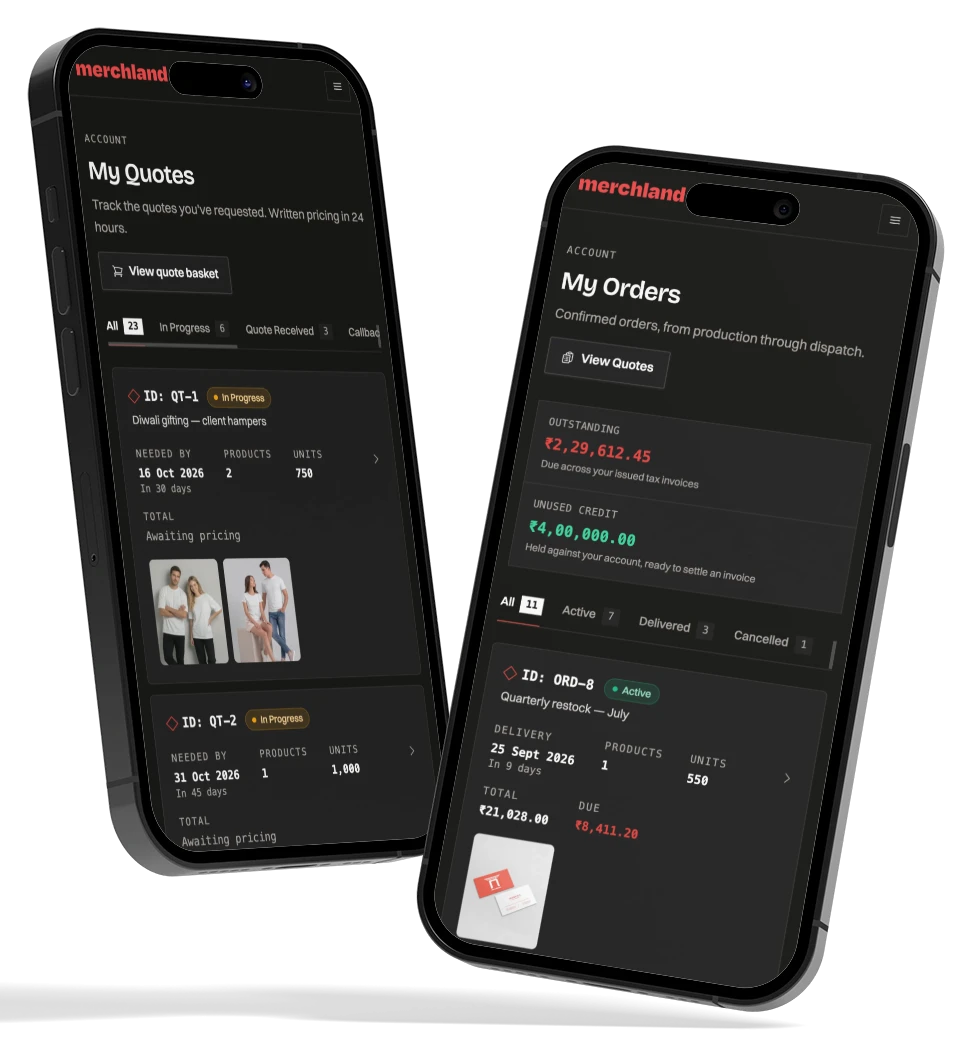
The checkout was the next assumption to go. A bulk order does not end when someone pays — it starts when someone asks. So every enquiry goes onto the same tracked path, and there is always an answer to "where is my order".
Acceptance is the line where the numbers stop moving. An accepted quote copies the vendor's unit cost, GST rate and HSN code onto its own lines, so a later edit to that vendor's price list can never rewrite money already booked.
- Browse and cart — the buyer picks products and quantities from the catalogue.
- Quote request — the whole cart goes in as one request, with the delivery date attached.
- Vendor matching — Merchland's team routes the request to the vendors who can actually make it.
- Competitive bidding — vendors reply with their own price for the job.
- Quote and acceptance — the platform writes one quotation PDF and sends it for approval.
- Order and fulfilment — the platform tracks production through to delivery, in view of the buyer.
04 — The Paperwork
Compliance built in, not bolted on.
We made each stage of an order produce its own paperwork, with nobody retyping anything: a quotation, a tax invoice, a supply contract for high-value orders, a receipt against payment, and a line sheet for the products. All five fill themselves in from the order record.
The invoice had to be exactly right. It works out which tax applies from where the goods are actually going, and locks that in at the moment it is issued so a later edit cannot change what was filed. If it cannot work the answer out, it declines to issue rather than guess.
That is what institutional buyers gate on. Procurement cannot pay against a chat message.
05 — Three Portals
Three portals over a single dataset.
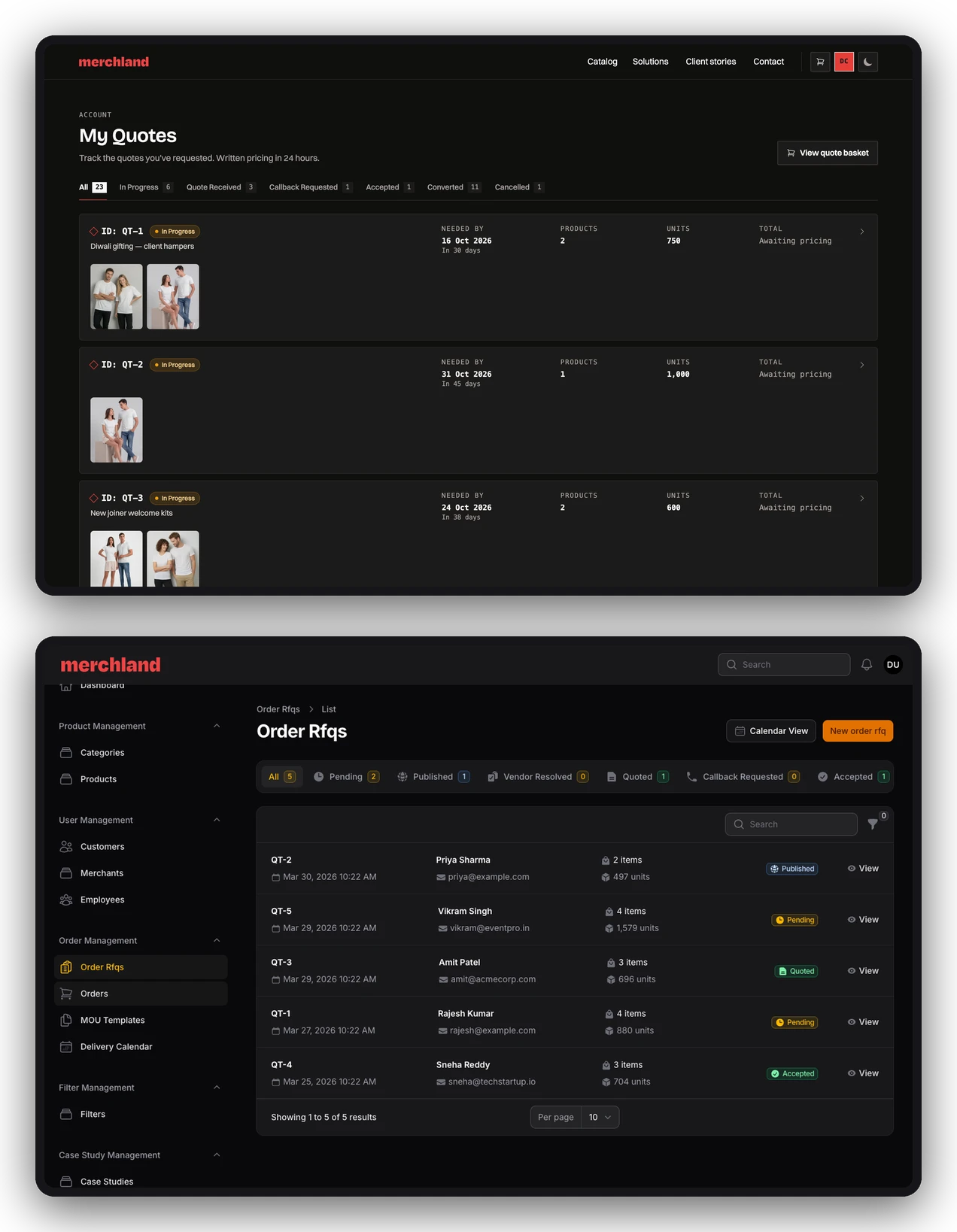
We gave every role its own view of the same data: a sales rep sees the requests assigned to them, a vendor sees only the job it is bidding on — never a competitor's price.
| Portal | Users | Key capabilities |
|---|---|---|
| Admin | Leadership | Full platform visibility, product management, customer database, financial reporting, delivery calendar |
| Merchant | Vendors | Price lists, bidding on open requests, fulfilment tracking, invoicing |
| Team | Sales and ops | Routing requests to vendors, matching, profit tracking with cost breakdown |
06 — Analytics
Numbers that survive an argument.
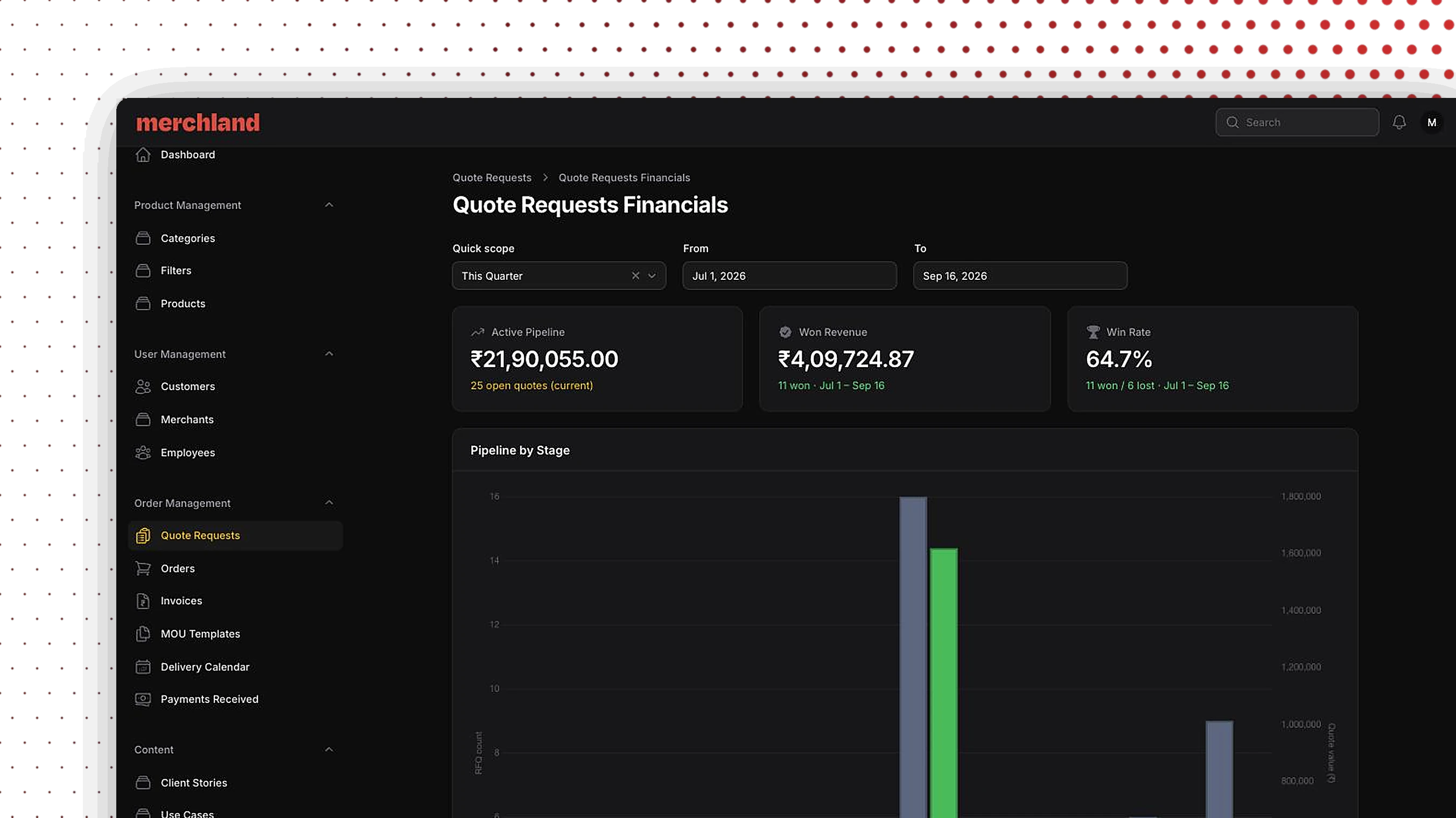
A marketplace that only takes orders is half a product. Because every quote, bid and order is one record rather than a thread, the platform can be asked questions about itself.
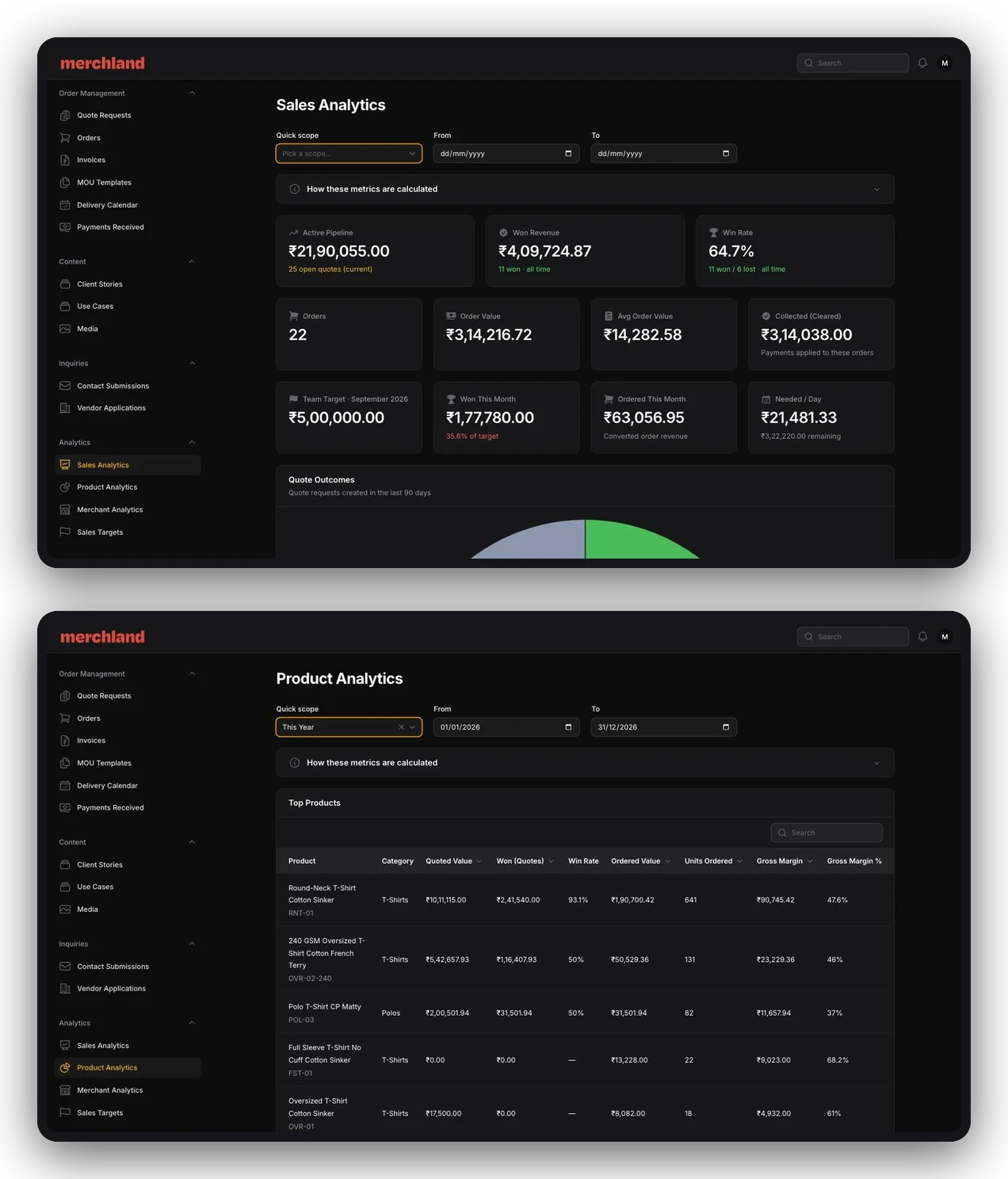
Sales. Pipeline by stage, win rate, revenue against the month's team target, a rep leaderboard and an action queue — what is open, what closed, and what is owed against the number the team committed to.
Product. Per product: what was quoted, what was won, what was ordered, and at what margin. The gap between quoted and won is demand that is not converting; the gap between won and ordered is agreement that has not shipped. Both are answerable per SKU.
Definitions, written down. Every dashboard carries a note on how each figure is calculated, so nobody relitigates what "won" means in a meeting.
07 — The Visual Language
A visual language borrowed from the manufacturer's ledger.
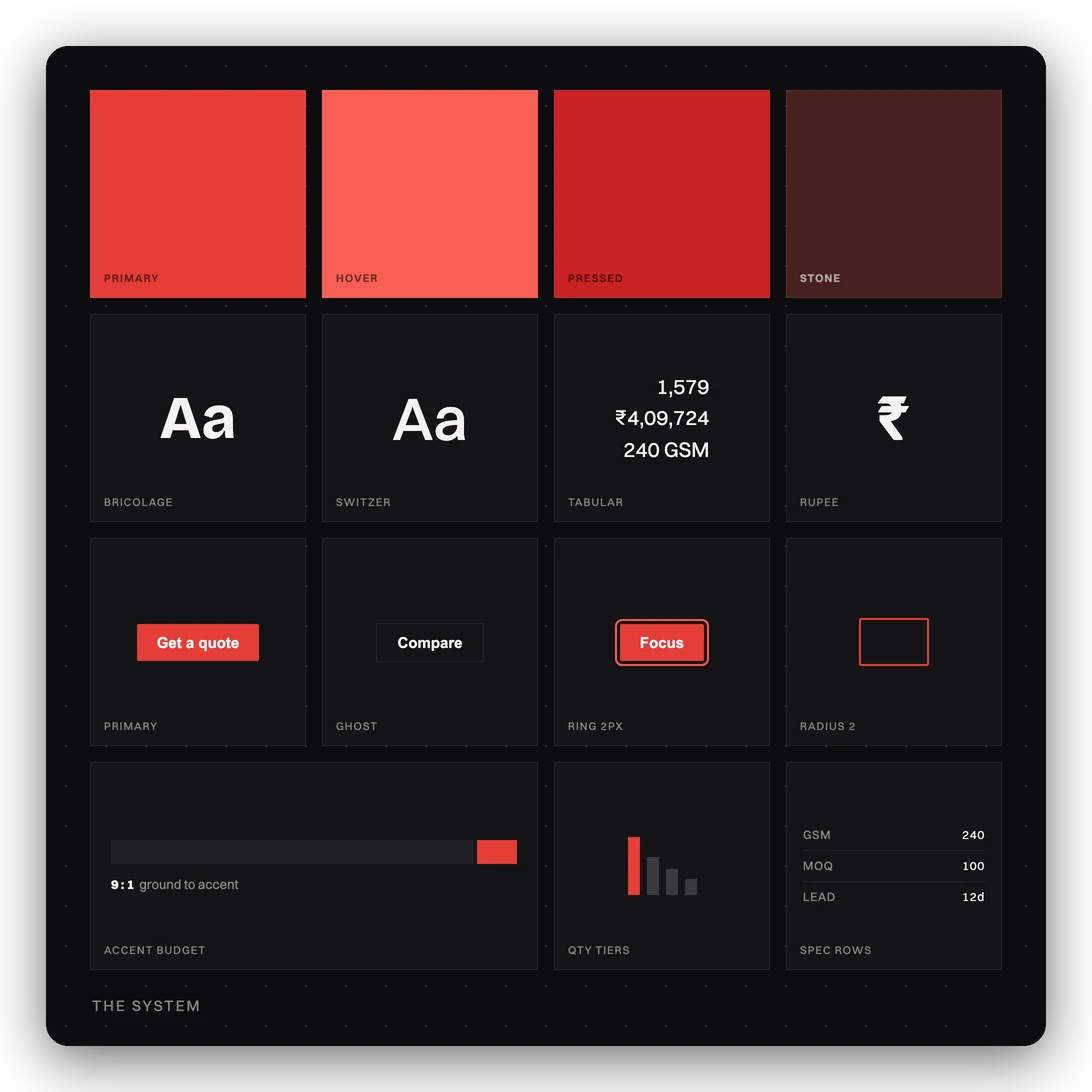
The reference was an editorial spread documenting a factory's production runs, not a SaaS landing page — warm stock, pressed ink, hairline rules between spec rows.
Bricolage Grotesque and Switzer carry it, both self-hosted. Every figure is set in digits of equal width, so a column of numbers reads as a column. A single vermillion signals action and does nothing else, capped at a tenth of any screen.
08 — Being Found
Built so Google, and the AI answering for it, can read it.
Most storefronts hand Google an empty page and ask it to build the site before it can read a word. We built Merchland's to arrive finished, so the whole catalogue is there on arrival — for Google, and for the models now answering on top of it. Cart, orders, payments and account stay out of search by one rule, so a private page is never one somebody forgot to hide.
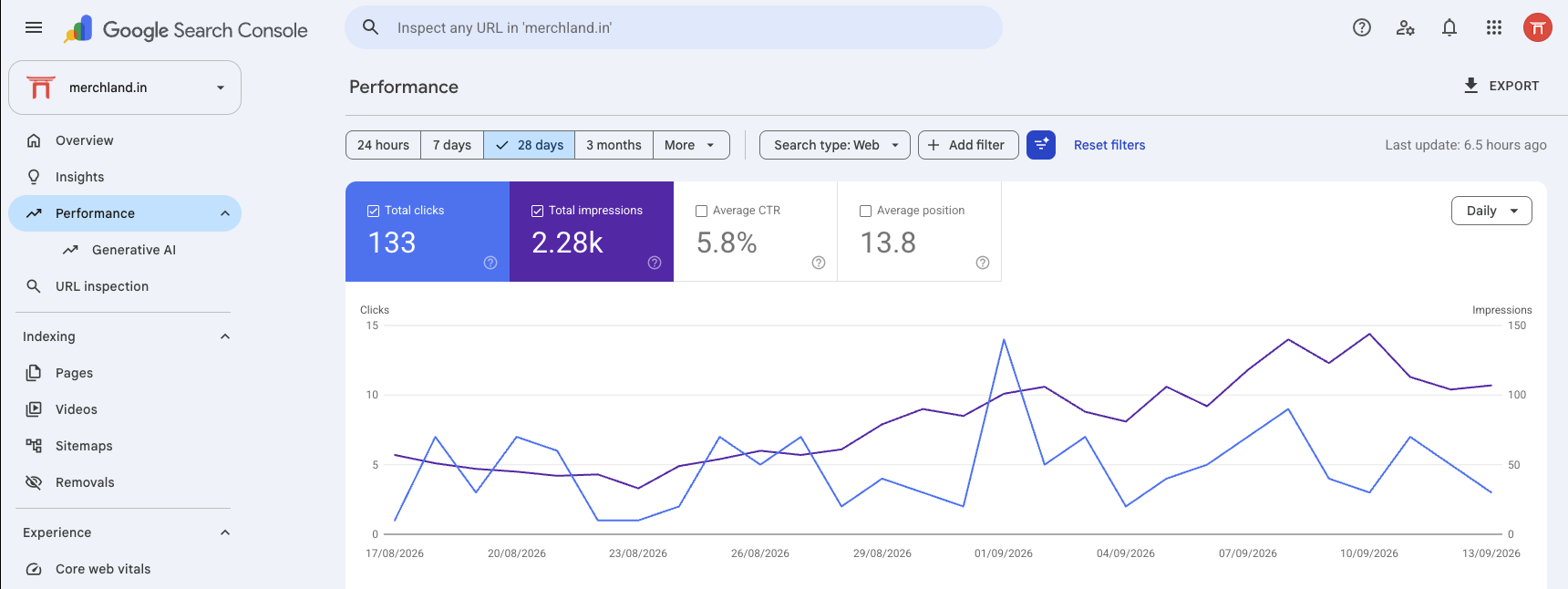
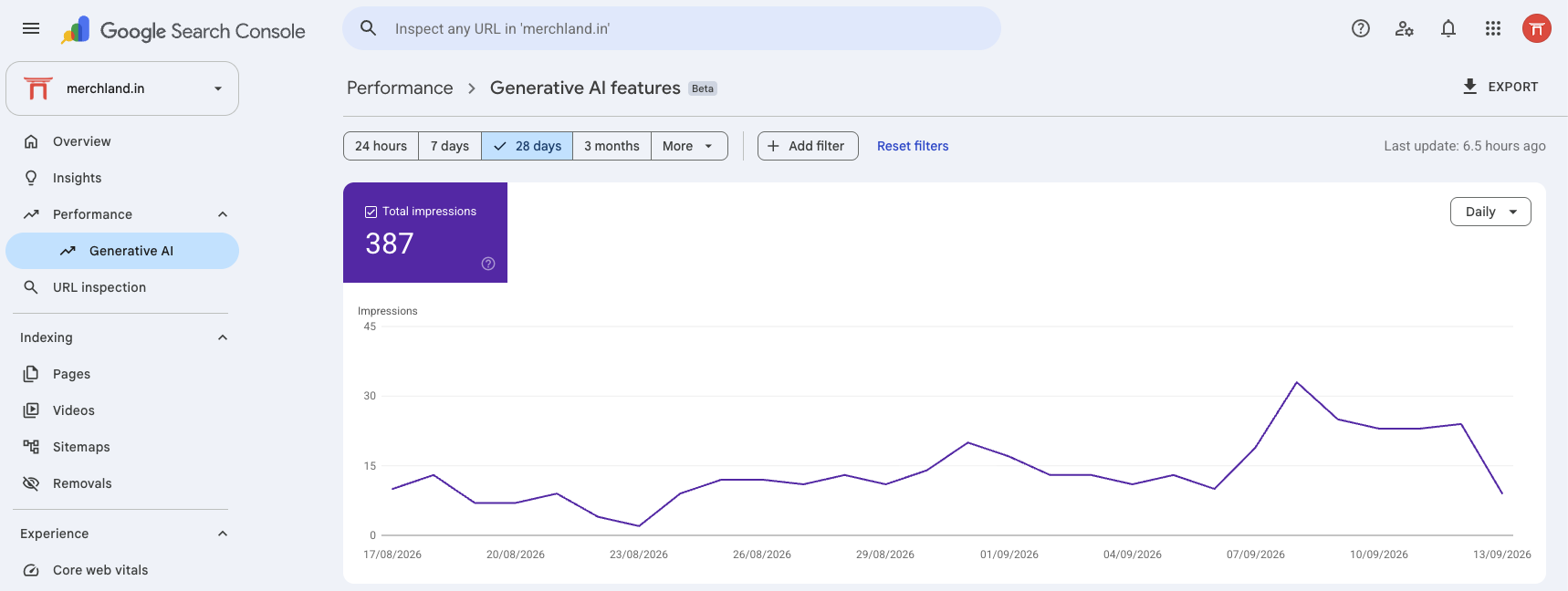
Over 28 days: 2,280 impressions, 133 clicks, and 387 appearances inside Google’s AI answers. Both screenshots are Merchland’s own Search Console.
Rankings compound on their own schedule. Being readable to whatever does the ranking is the part we control.
09 — Snapshot
The Merchland build: scope, stack, and what shipped.
| Client | Merchland |
| Segment | B2B merchandise marketplace |
| Scope | ERP development services — storefront, vendor network, quote-to-order ERP, document automation |
| Portals | Admin, merchant, team |
| Catalogue | 74 products, 65 of them multivariant, each with vendor rate charts in quantity tiers |
| Buyers on the platform | Corporates, event organisers, creators and campus festivals — Spring Fest (IIT Kharagpur), Backwaters (IIM Kozhikode), SPICMACAY (IIT Guwahati). Merchland's customers, not ours |
| Repeat rate | 21%, with near-zero paid acquisition |
| Fastest large order | 602 units in 11 days, against a 3–4 week industry norm |
10 — FAQ
What buyers ask about ERP development services.
Why build a custom catalogue instead of using Shopify or Magento?
Because merchandise breaks the assumptions those platforms make. One product can carry colour, size, fabric weight, material and print method at once, and the sellable combinations multiply fast. Our model generates every combination in bulk and answers a filtered search in 2.5ms, against 6.7ms for Magento 2 doing the same work. And buying in B2B is not checking out: an off-the-shelf cart has no idea what a quote request, a vendor bid or a quantity-tiered price is.
How does a buyer get a price if vendors bid competitively?
The buyer asks for what they need instead of checking out. Merchland's team routes the request to vendors who can make that product, and they reply with prices that step down as the quantity goes up. The best match wins, and the buyer receives one quotation PDF. The bidding stays behind the scenes — the buyer deals with Merchland, not with five suppliers.
Does the platform issue GST-compliant invoices?
Yes, and it picks the right tax treatment on its own from the buyer's registered tax number and address: a single combined tax (IGST) when the order crosses an Indian state line, a split state-and-central tax (CGST+SGST) when it does not. It also writes quotation PDFs with the tax broken out, and supply contracts that fill themselves in from the order record. Most of the informal market cannot issue a compliant invoice at all, which is what locks it out of institutional procurement.
How is a 21% repeat rate achieved with near-zero acquisition spend?
It is word of mouth. A customer is worth more than 50 times what it costs to win one, because winning one costs almost nothing. Institutional merchandise buying is a small, well-connected world — festival organisers move between committees and recommend what worked. The platform makes that recommendation safe to act on: one accountable supplier, an order you can watch move, paperwork the finance office accepts.
What does an ERP build like this cost?
A single-module ERP build starts in the range of a mid-size web application. Merchland is larger than that — catalogue, quote-to-order workflow, vendor network, document generation and three separate portals — so it is a programme rather than a project, quoted after a discovery phase.
We price discovery separately, so you can stop after it holding a specification you own — whoever ends up building it. We work in two-week sprints, so there is working software to look at from week two, not a reveal at the end.
Technologies used
Frontend: Vue.js and Nuxt, with Capacitor shipping the same code to mobile.
Backend and infrastructure: Laravel with Filament, API documentation generated from the code itself, Sentry error tracking, and automated deploys to staging and production.