JetPaxTicketing platform and ERP back office for India's live events
- Custom Software Development
- UI/UX Design
- ERP & Enterprise Systems
- Mobile App
- Events & Ticketing
- Kolkata, India
- Live site
01 — The Challenge
One platform for hosts, artists, venues and fans.
JetPax asked us to build the whole thing: a storefront event-goers buy from, portals that hosts, artists and door staff work in, and the settlement machinery between them.
The storefront was never the hard part. India runs 30,000+ independent events a year across 300+ cities, and most of those hosts are small enough to sit below the GST registration threshold. So the tax engine could not be a rate applied at checkout. It had to establish who the host actually is before it deducted anything from them.
Three assumptions borrowed from ordinary commerce had to go: that tax is a percentage added at the end, that a payout is a transfer, and that money is a number you can multiply.
The incumbent set the bar on the one thing a host actually feels — it settles in 15–30 days, long after the artists, the venue and the vendors have been paid out of the organiser's own pocket. Commission was never the lever; JetPax's own top tier charges 10% too. The clock was.
02 — Five Portals
Five role-based portals, one permission model.
We split the product into five portals over one dataset, so each role sees exactly what it needs and nothing else — a manager doing door duty cannot see a single financial figure.
| Portal | Users | Key capabilities |
|---|---|---|
| Host | Event organisers | Event creation wizard, ticket tiers, promo codes, real-time sales dashboard, payout tracking with tax breakdown |
| Artist | Performers | Portfolio with media embeds, booking enquiry inbox, KYC verification, engagement analytics |
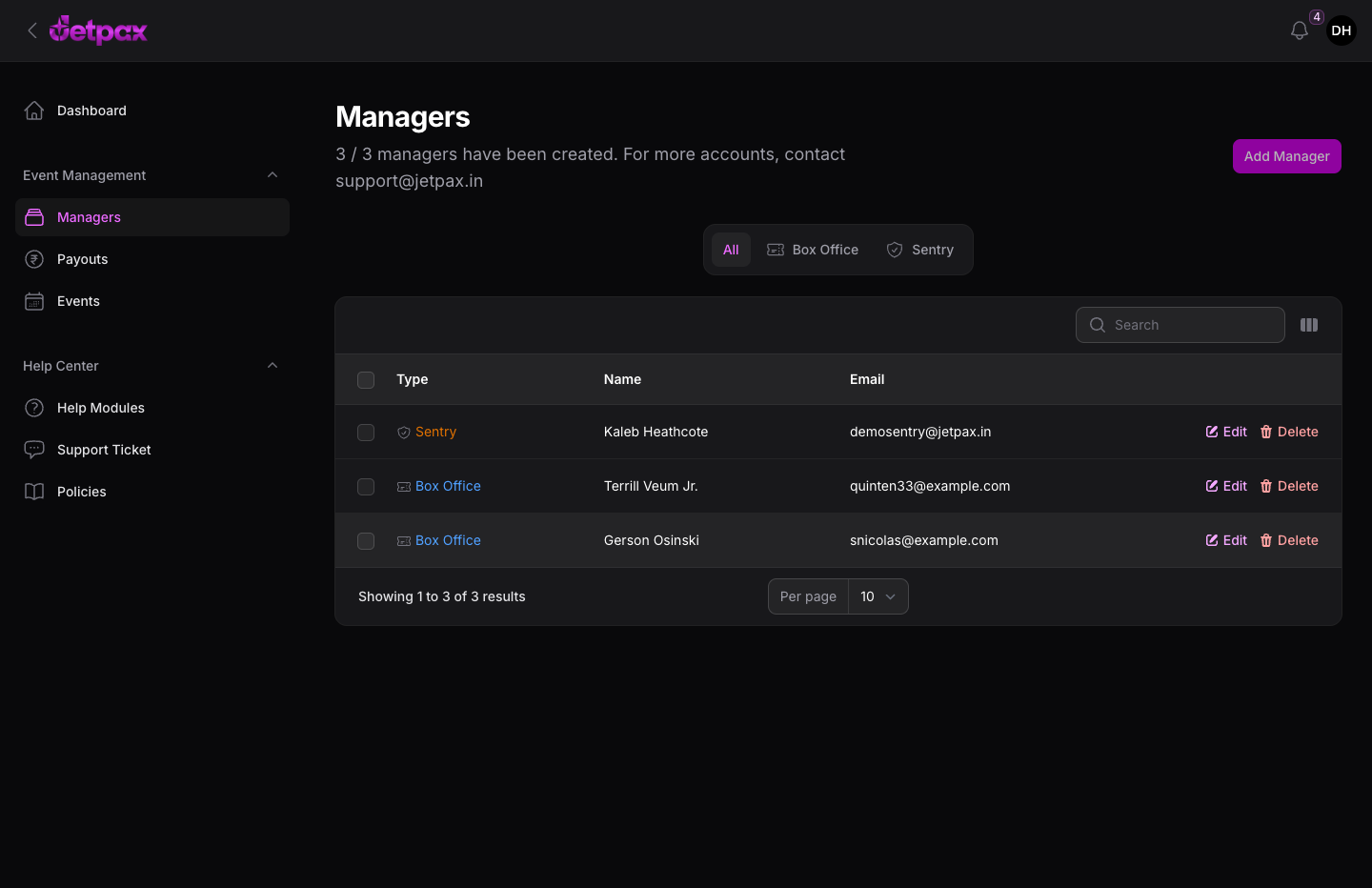
| Manager | Operations staff | Day-of check-in, attendance tracking, scoped access with no financial visibility |
| Admin | Platform team | Event approvals, KYC review pipeline, payout processing, system health monitoring |
| Attendee app | Event-goers | City discovery, instant search, secure checkout, QR tickets, bookmarks, reviews |
03 — The Compliance Engine
Tax that branches, and money that never rounds twice.
TCS is withheld at 0.5% — but only where the host is GST-registered. Below that threshold the deduction does not apply at all, and a platform that withholds anyway has taken money it cannot account for. So the engine establishes registration first and deducts second.
Where TCS does apply, the split is geographic. Measured against JetPax's own state, a host in the same state splits CGST and SGST at 0.25% each; a host in a union territory splits CGST and UTGST; everyone else is IGST at the full 0.5%. TDS is a separate calculation on a separate base — 0.1% of the whole sale including GST, a basis confirmed with a chartered accountant and pinned in the code, because changing it would change amounts already filed on Form 26Q.
Commission is charged on the net sale excluding the host's own GST, per Section 15, and carries 18% GST of its own.
Underneath all of it, money is integer paise and never a float. Every percentage rounds exactly once — chaining a multiply and a divide rounds twice and can differ by a paisa. Halves are derived by subtracting the first from the whole, so CGST and SGST always re-sum to the tax they came from. A paisa lost here is a return that does not reconcile.
The platform exports GSTR-1, GSTR-3B, GSTR-8, Form 26Q and an annual TCS statement from the same ledger the host was paid out of.
Most platforms bolt tax on at the end of the year. JetPax computes it on every transaction, so the number a host sees on the night is the number that reconciles.
04 — Discovery and Reach
Discovery across 300+ cities — web, PWA and Android from one codebase.
We built discovery city-first and genre-aware, with Algolia-backed instant search so results land as the attendee types. Checkout runs through Razorpay with promo code support, and tickets are issued as QR codes that door staff scan from the manager portal.
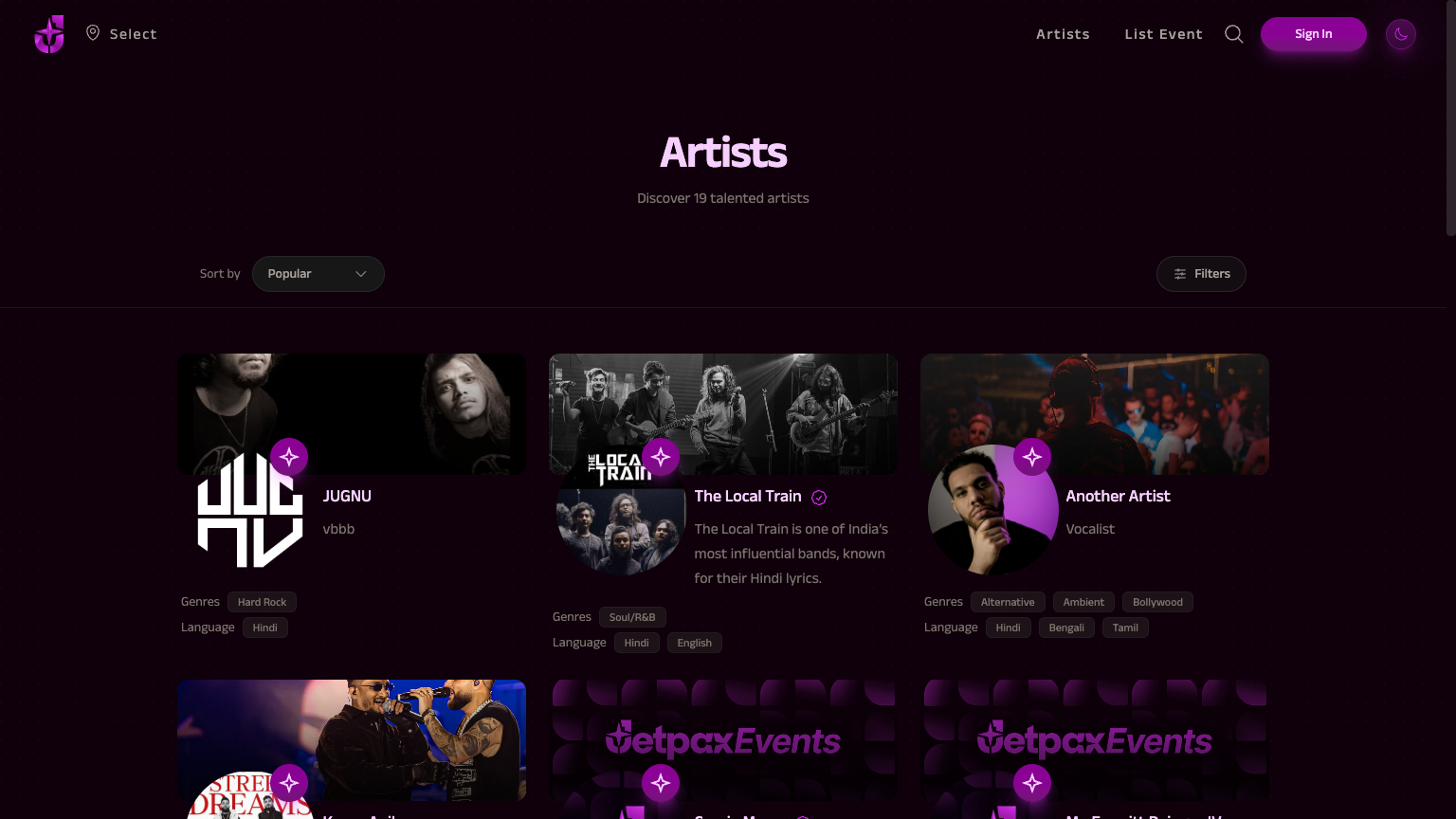
The artist side is a booking surface in its own right: portfolio pages embed YouTube, Vimeo, Spotify and SoundCloud, enquiries arrive in a managed inbox, and KYC clears through a document workflow before money moves.
Web, PWA and Android all ship from a single Nuxt codebase wrapped with Capacitor — one project to build, one to maintain, and iOS is a platform target away rather than a second build.
05 — Running the Platform
The ERP back office: approvals, KYC, payouts, monitoring.
We built the operator side to the same standard as the storefront. Hosts add managers with scoped permissions and track attendance through QR check-in; behind them, the platform team works an event approval queue, a KYC pipeline for hosts and artists, automated payouts through RazorpayX, and health monitoring with alerting.
The payout window is a plan tier rather than a promise: eight days on the entry plan, five and three on the tiers above it. Speed is something a host can buy, and the commission rate rises with it — which is an honest trade to put in front of an organiser, and a rule the engine enforces rather than a salesperson.
06 — The Visual Language
Two registers: editorial for the crowd, utilitarian for the desk.
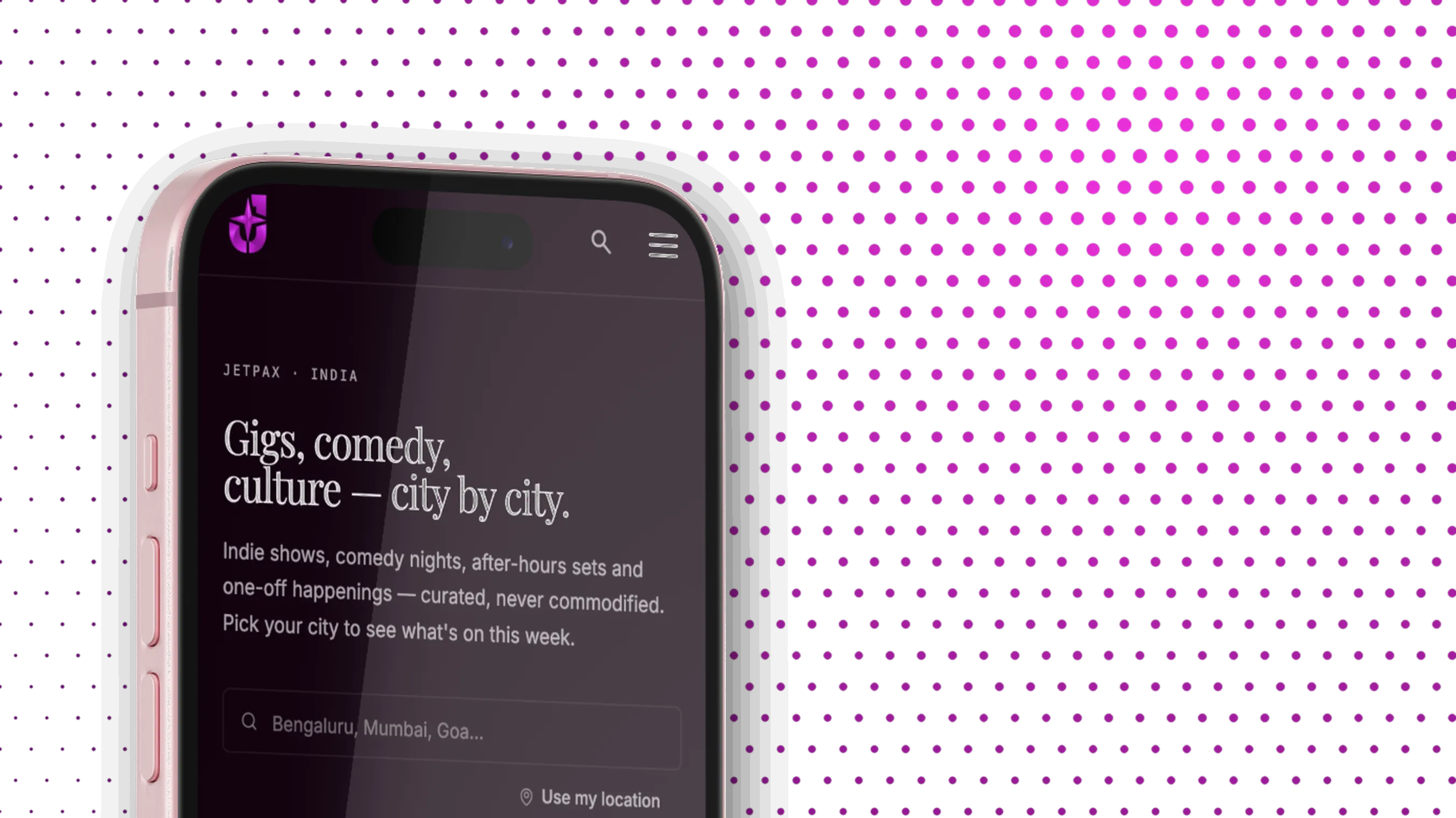
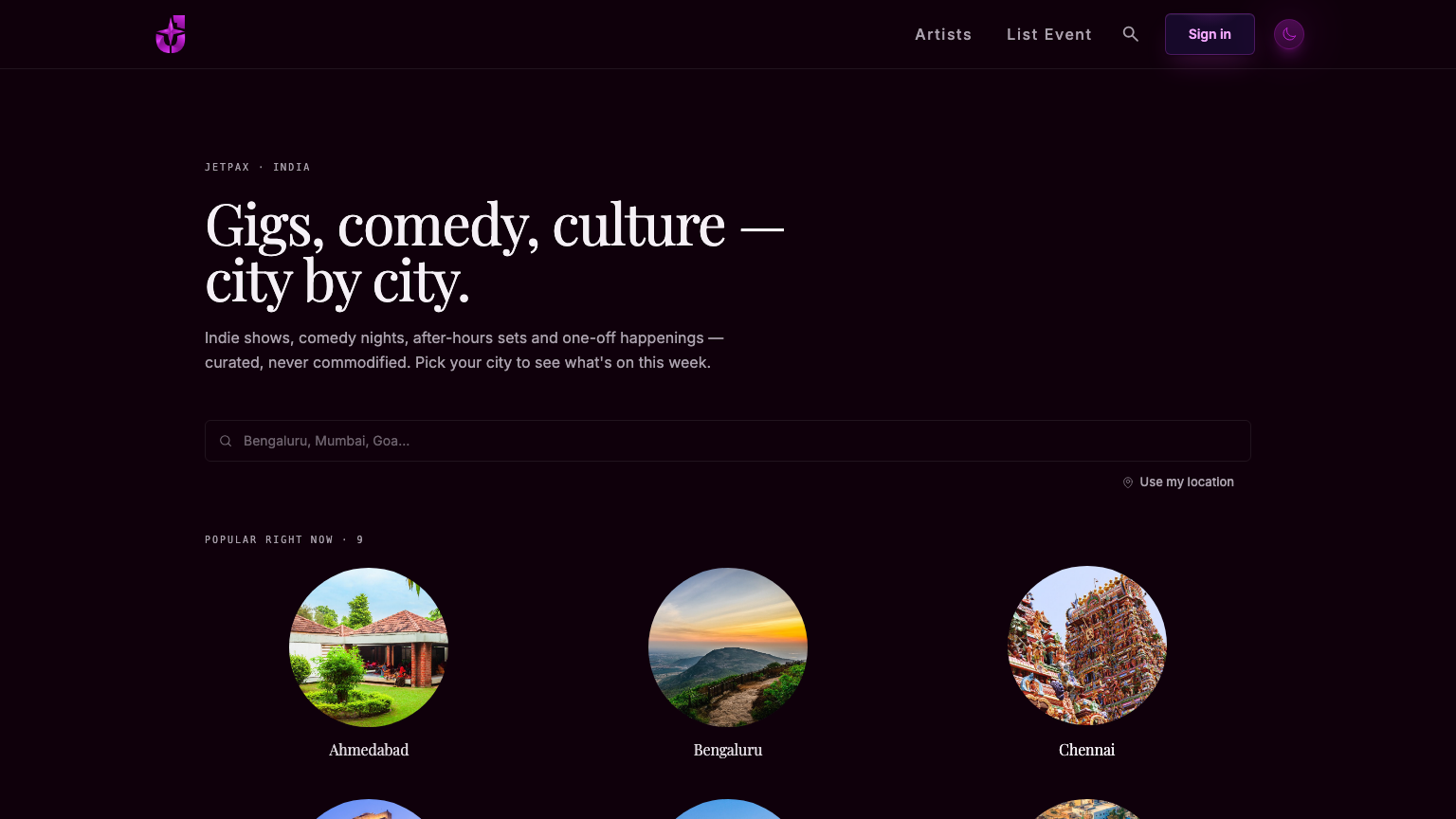
We set the public side like a listings magazine rather than a checkout funnel. A high-contrast serif carries the headlines, monospace eyebrows label each row, and city photography sits in circular crops on a near-black plum ground — a page that looks like something printed for a night out.
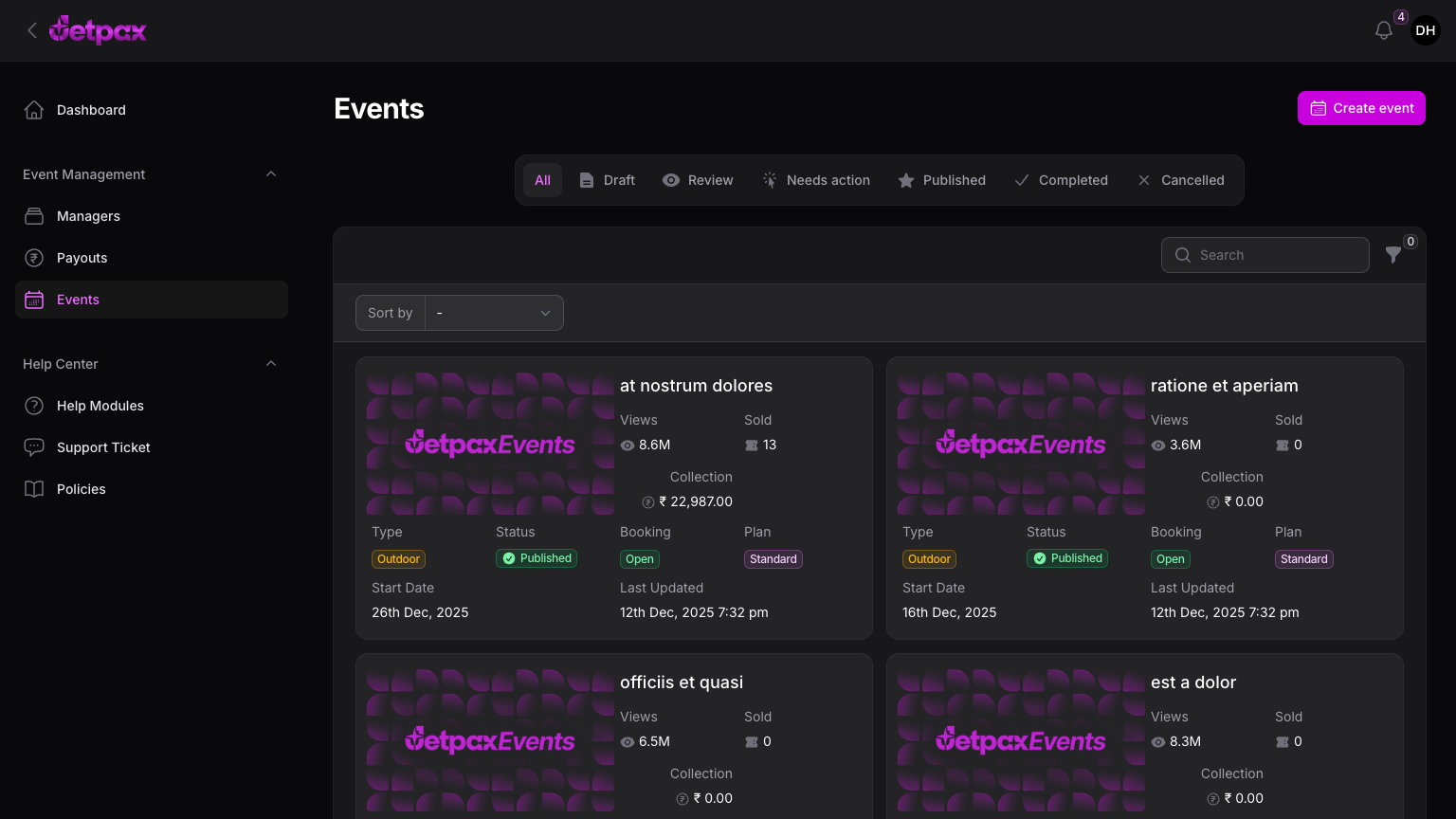
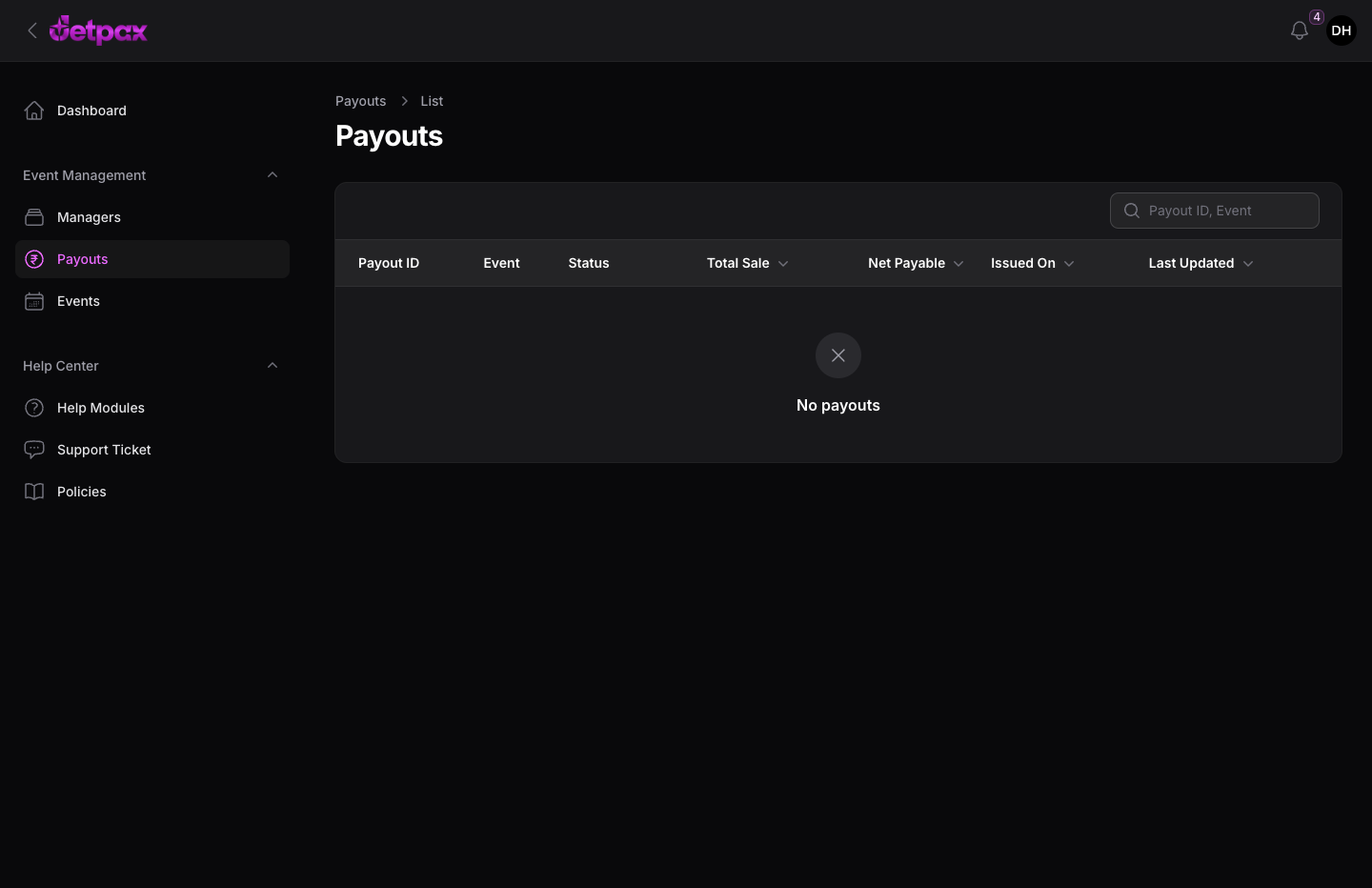
The host and admin portals drop the serif entirely. Same mark, same accent, but the display face gives way to a dense sans and the page becomes a sortable table of payout IDs, net payable and issue dates. A host reconciling a settlement is doing accounting, not browsing, and the interface stops performing at them.
One brand, two registers. Only the wordmark and the magenta cross between them.
07 — Snapshot
The JetPax build: stack, scope, shipping model.
| Client | JetPax, Kolkata |
| Segment | Live events and ticketing |
| Scope | Custom software development — product design, full-stack build, mobile app development, compliance engineering |
| Portals | Host, artist, manager, admin, attendee app |
| Platforms | Web, PWA, Android — one codebase |
| Payout cycle | 3–8 days by plan tier, automated, with full tax breakdown |
| Compliance | GST, TCS and TDS applied per transaction; GSTR-1, GSTR-3B, GSTR-8, Form 26Q and annual TCS exports |
08 — FAQ
What buyers ask about custom software development for ticketing.
How does JetPax settle hosts in 3–8 days when the industry takes 15–30?
Settlement is computed rather than assembled by hand. The moment an event is marked complete, the platform works out the payable amount, withholds TCS and TDS against it, and releases the transfer through RazorpayX without anyone touching the arithmetic. The tax breakdown is attached to the payout, so there is nothing to reconcile afterwards — which is what usually causes the delay elsewhere. The exact window is a plan tier: eight days, five or three.
Which Indian taxes does the platform handle automatically?
Three, and the interesting part is that two of them branch. GST is charged at checkout and split into CGST+SGST or IGST by the buyer's state. TCS at 0.5% is withheld under the e-commerce operator provisions — but only from GST-registered hosts, and it splits three ways depending on whether the host sits in the platform's own state, a different state, or a union territory. TDS at 0.1% is deducted at settlement under Section 194-O, on a base that includes GST. Hosts get compliant invoice PDFs, and the platform team exports GSTR-1, GSTR-3B, GSTR-8, Form 26Q and an annual TCS statement.
Why five separate portals instead of one dashboard with permissions?
Because the roles have genuinely different jobs and genuinely different risk. An operations manager scanning tickets at the door should not be one misconfigured permission away from the event's revenue figures. Separate portals over one shared dataset let each role get an interface built for its task, with boundaries enforced server-side rather than hidden in the UI.
Is the mobile app a separate build from the website?
No. Web, PWA and Android all come from the same Vue and Nuxt codebase, wrapped for the store with Capacitor. A feature is written once and ships everywhere, which is what makes a multi-platform product maintainable for a team this size — and it is why adding iOS is a platform target rather than a second codebase.
How long does a platform like this take to build?
Five role-based portals, a compliance engine and four shipping targets is a full-featured platform rather than an MVP, and that band runs 4–8 months. A focused MVP — one portal, one platform, no tax engine — sits at 8–12 weeks instead.
The compliance engine is the part that resists compression. Tax arithmetic has to be right before anything built on top of it can be trusted, so it gets built early and reviewed hard. We work in two-week sprints, so there is working software to look at from week two rather than a reveal at the end.
Technologies used
Frontend: Vue.js and Nuxt, TypeScript, Tailwind CSS, Capacitor for Android.
Backend and infrastructure: Laravel with Filament, MySQL and Redis, Algolia for search, Razorpay and RazorpayX for payments and payouts.